

Baba Yaga’s hut stands hidden deep within the forest, no ordinary dwelling. It creaks, it shifts, and it watches. Every movement sends a shiver through the trees, as though the forest knows that something has awakened. Finding the hut is difficult. Approaching it is harder still.
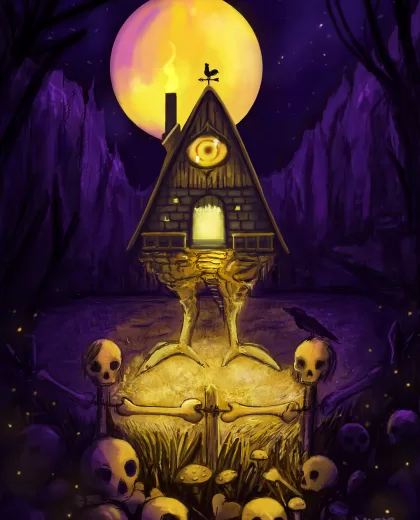
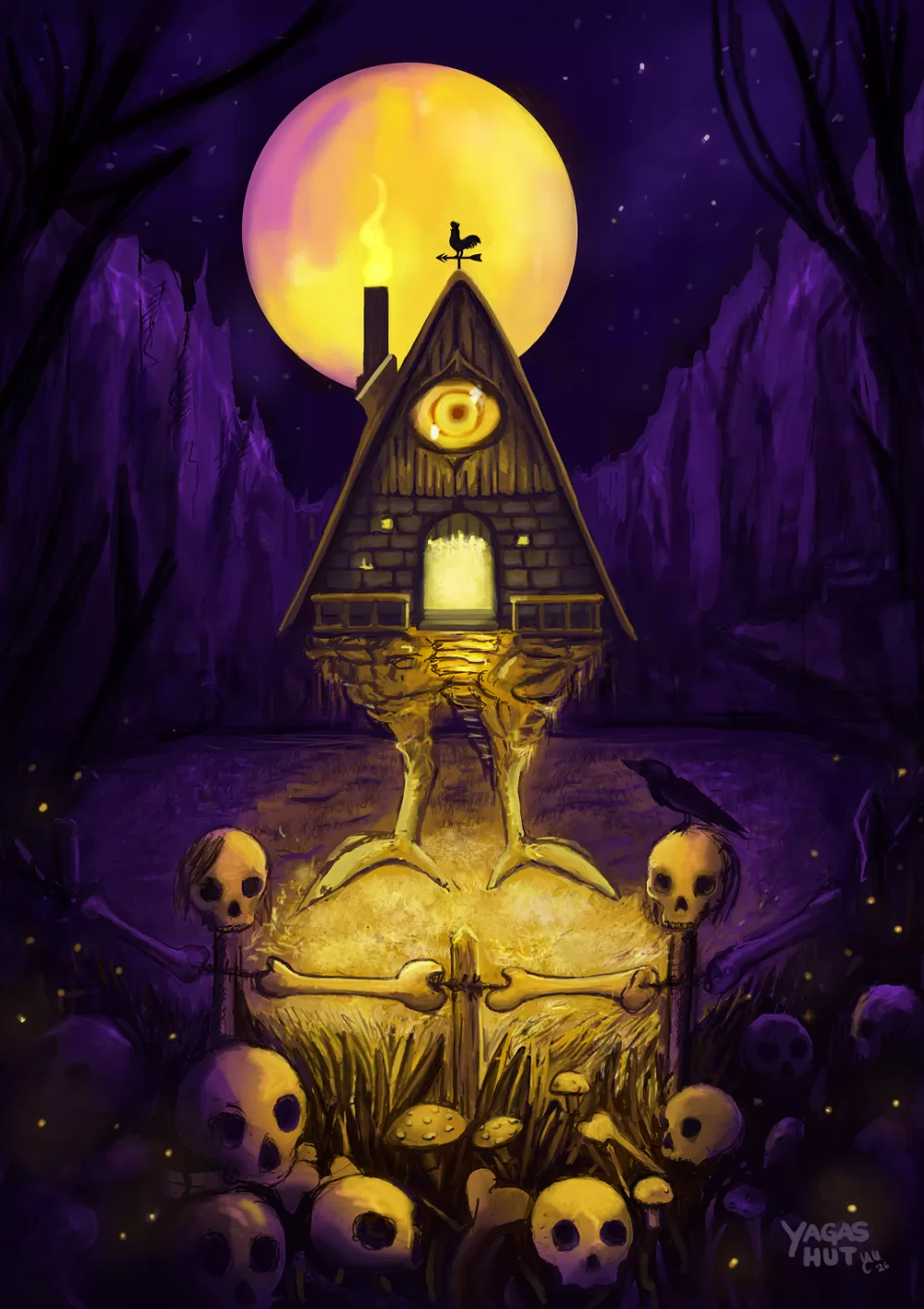
Throughout Eastern Slavic folklore, the hut is remembered almost as often as Baba Yaga herself. It stands upon towering chicken legs and is surrounded by a fence of human bones, marking the place where the familiar world quietly gives way to something older.
Fence of Bones
In the tale of Vasilisa the Beautiful, the hut is surrounded by a fence woven from human bones. Skulls rest upon its posts, and their empty eyes shine through the darkness like lanterns. One post remains bare, waiting for another skull to complete the fence.
The fence is more than a boundary. It is a promise. Others have reached this place before, and not all returned. Their pale glow lights the way towards the gate, but it never reveals what waits beyond it.
Step too close without permission, and you may find your own skull upon the fence.
Chicken Legs
Beyond the fence stands the hut, balanced on towering chicken legs. It moves through the trees, sometimes squatting low to scratch the earth before rising again to continue its wandering. The door is never where you expect it to be, and it turns away from all who approach.
Standing before the hut is only the beginning. The doorway refuses every stranger, turning away no matter where they stand. Only those who know the ancient incantation can make the hut stop and face them. For everyone else, it remains a riddle of wood and claw hidden beneath the forest canopy.
Only the bold, or the foolish, call out the words that make it turn.
The Words That Turn the Hut
Russian folk tales remember a single command used by those who wish to cross the hut’s threshold. The words have passed from one storyteller to the next for generations, preserved almost unchanged.
“Little hut, little hut, turn your back to the forest, your front to me.”
At those words, the chicken legs fold, the door swings around, and the way inside is revealed. The hut turns only when the ancient words are spoken. Otherwise, it simply turns away once more.
Guardian & Threshold
The hut is the living guardian of Baba Yaga’s threshold. It reveals its doorway only to those who know the ancient words. What waits beyond depends upon Baba Yaga.
Crossing the threshold means leaving the ordinary world behind. Vasilisa the Beautiful enters seeking fire and returns carrying both light and hard-earned wisdom. Many heroes make the same journey, whether searching for distant kingdoms, impossible answers, or figures such as Koschei the Deathless. Before any of them reach Baba Yaga, they must first pass her hut.
Not all doors open with keys. Some demand courage and the right words.