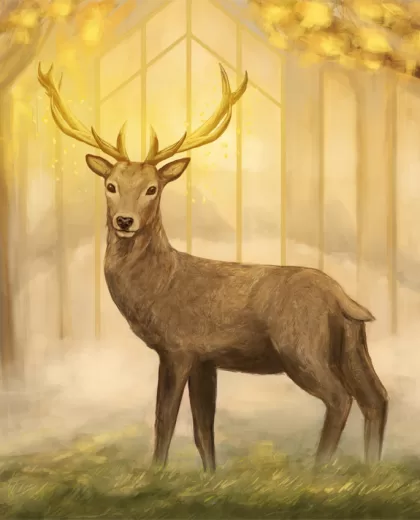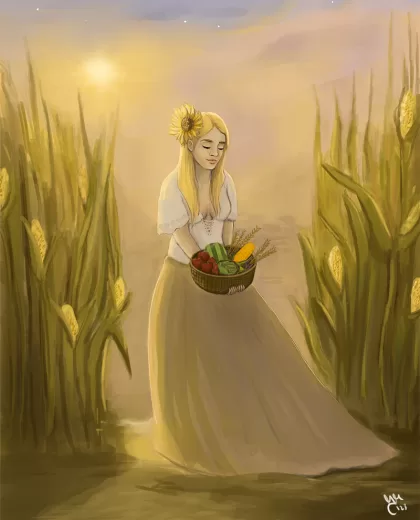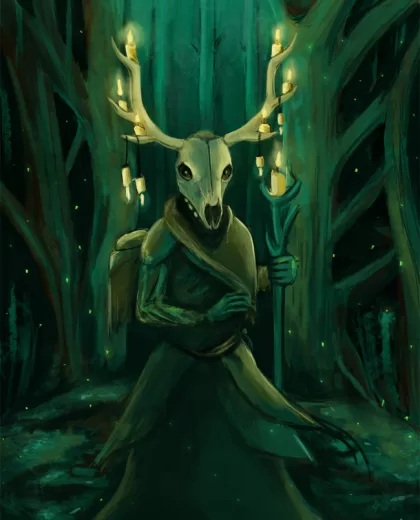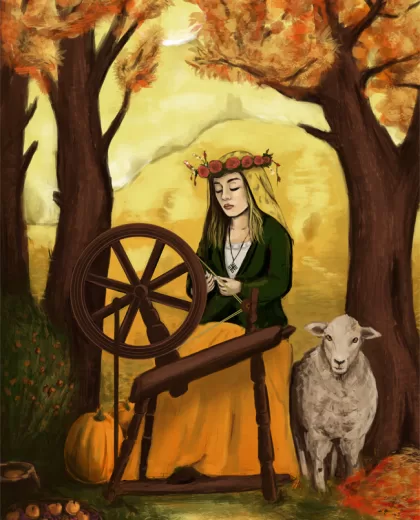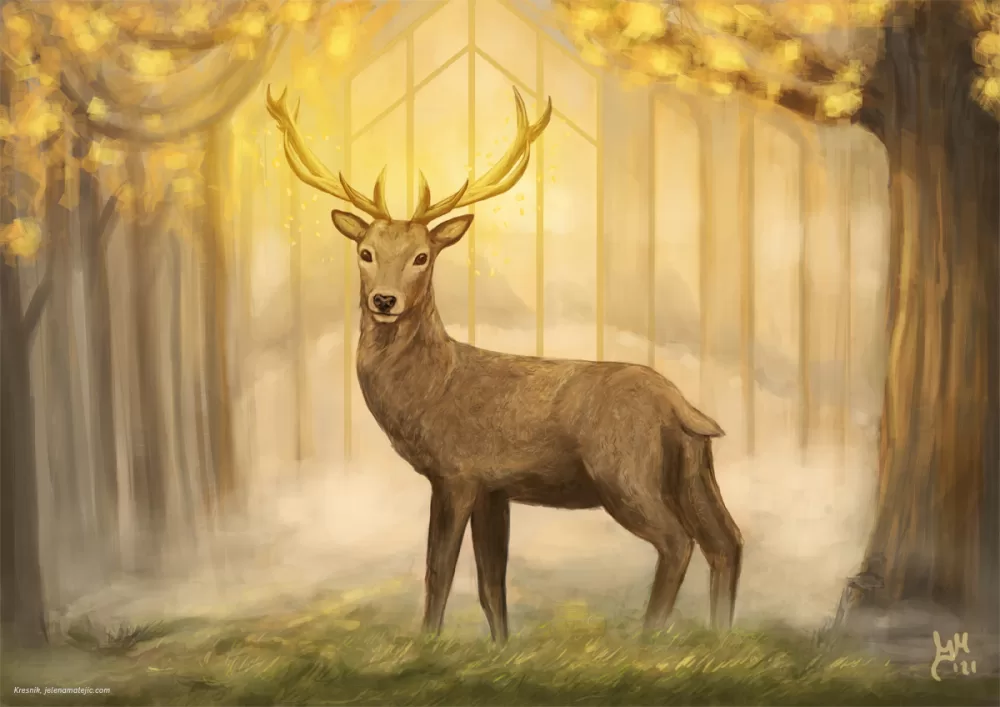


Kresnik is remembered in Slovenian folklore as a hero of fire, summer, and the life-giving sun. His victories bring back the rain, strengthen the harvest, and restore life to the land. Some traditions remember him as a shining warrior, others as a golden-antlered stag crossing the high mountains at dawn.
Whether remembered as a god, a hero, or the echo of an older solar deity, Kresnik belongs to the moment when darkness breaks and life begins to stir again.
The Radiant Warrior
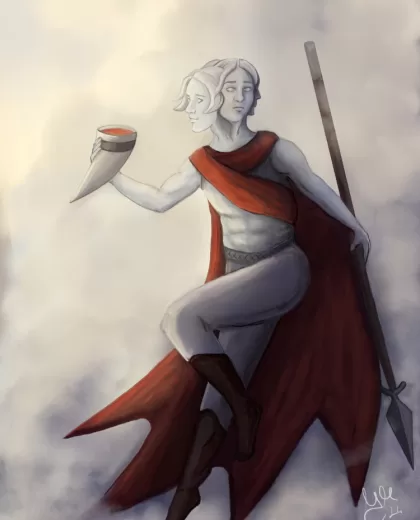
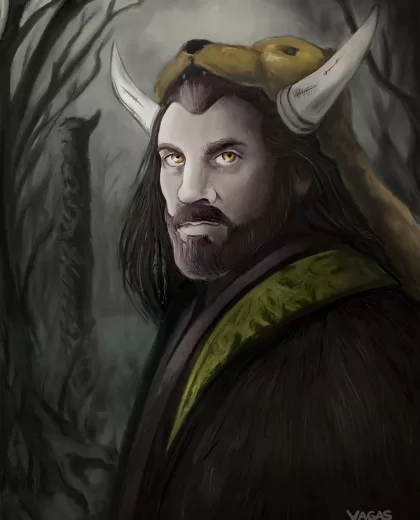
Kresnik is described as a luminous warrior dressed in gold, or as a stag whose antlers carry the light of the rising sun. Whether warrior or stag, he arrives with the first light of summer.
In some tales, he rides through the sky or crosses the mountain peaks with such brilliance that no shadow can remain beneath his gaze. His coming marks the return of warmth, light, and the first signs of summer.
When Kresnik runs, the fields bow and the beasts rise.

The Battle Against Darkness
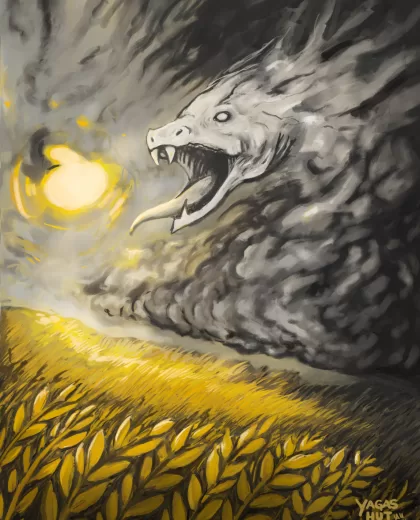
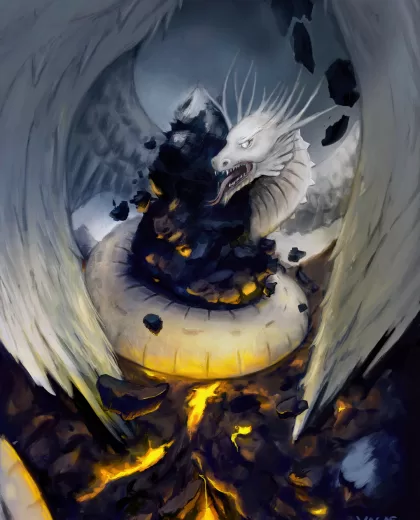
At the heart of Kresnik’s legend is a struggle against forces that withhold water, threaten cattle, or bring barrenness to the land. His opponent may appear as a serpent, a many-headed dragon, or another chthonic being, such as the Zmey. In some interpretations, this conflict echoes the older mythic battle between the thunder god Perun and the underworld god Veles.
Kresnik’s victory is never only personal. When the serpent or dragon falls, rain is released, the fields recover, and life returns to the earth. The stories tell the battle differently, but they all end the same way: the rain returns, and so does life.
Where Perun strikes from the sky, Kresnik descends from the mountain. One commands the thunder. The other brings back the light. Together, their victories restore the land.
He does not conquer for glory. He fights so the earth may breathe again.
The Golden Mountain
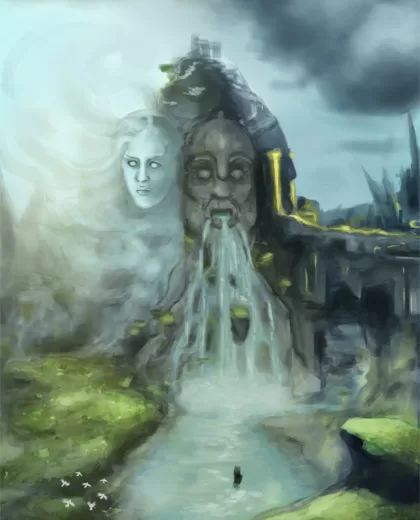
Kresnik is often placed upon a distant Golden Mountain or Crystal Mountain, a luminous realm standing between earth and sky. It is a place set apart from the ordinary world, unreachable by familiar roads and guarded from mortal hands.
Some later retellings describe gardens growing upon its heights, where golden apples shine beneath an eternal sun. Whoever tastes their fruit is said to escape age and death.
Few ever reach the orchard. The path disappears, the slopes turn against the traveller, and the light remains beyond reach.
The golden apples gleam eternal beneath an endless sun.

Fires of Midsummer
Kresnik’s name became closely associated with midsummer, when bonfires burned upon the hills and flaming wheels were sent down the slopes like fragments of the descending sun. Communities gathered around the fires, leapt across their flames, and carried home herbs collected during the shortest nights of the year.
These customs later became intertwined with the feast of St John, yet they preserved older themes of fire, water, fertility, and protection. The flames guarded fields and homes, while rain and dew promised abundance for the season ahead.
The word kres became closely associated with ceremonial fire and midsummer bonfires. Over time, Kresnik’s name remained tied to these seasonal rites. On Kresna noć, herbs such as yarrow, fern, and St John’s wort were gathered before dawn and carried home for protection.
They leapt through the flames to carry the light home.

God, Hero, or Svarožić?
Many traditions remember Kresnik differently, and no single story tells all of them. Some scholars have compared him with Svarožić, the younger deity associated with sacred fire, while others have connected his battles with the mythic conflict of Perun and Veles. In many Slovenian tales, however, he appears less as a distant god and more as a radiant hero whose victories protect the human world.
His name is also related to the krsnik of Croatian and Istrian folklore. These figures are not always identical. The Istrian krsnik is often described as a human protector born with supernatural abilities, who battles witches and harmful forces on behalf of the community. Their names are similar, but over time the traditions followed different paths.
Different traditions remembered Kresnik in different ways. He appears as a solar warrior, a dragon slayer, a master of sacred fire, or a guardian who fought unseen battles for the land.
After the Longest Night
Whether remembered as a god, a hero, or the echo of an older solar deity, Kresnik has always stood on the side of life. His fires burn against darkness, his victories release the waters, and his return marks the moment when even the longest night gives way to dawn.
Those who honor the light of Kresnik carry the strength to banish their own shadows.